
PRESENTATION ARCHIVE
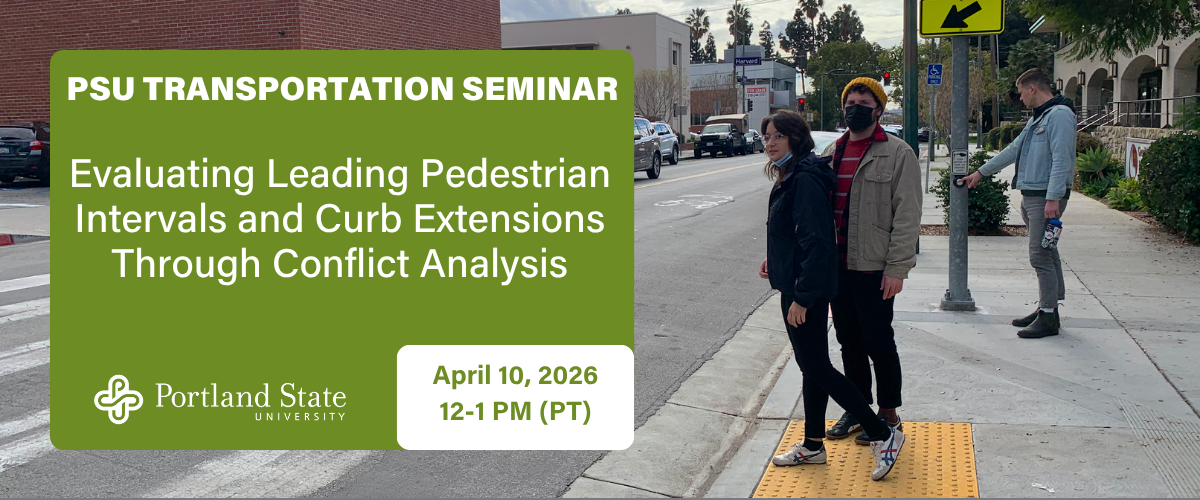
Leading Pedestrian Intervals (LPIs) and curb extensions are widely used street design strategies intended to improve pedestrian safety at signalized intersections. However, while LPIs have a well-documented crash reduction record, fewer studies have examined how these treatments influence near-miss interactions or how geometric changes like curb extensions interact with signal timing strategies.
This seminar presents findings from a Master’s thesis that evaluated the safety impacts of LPIs and curb extensions using detailed conflict data collected at signalized intersections in the Portland, Oregon metropolitan area. Approximately 600 hours of video were manually reviewed to identify pedestrian crossings, vehicle movements, and conflict events using Post Encroachment Time (PET) and turning-speed thresholds. The analysis combined descriptive statistics, statistical tests, and regression modeling to understand both conflict frequency and severity.
Results show that LPIs are consistently associated with lower pedestrian–vehicle conflict frequency, while intersections with both LPIs and curb extensions generally exhibited lower proportions of high-severity conflicts. The presentation will discuss the methodology, key findings, and practical implications for agencies considering pedestrian safety treatments.
KEY LEARNING OUTCOMES
- Understand how surrogate safety measures (e.g., Post Encroachment Time) can be used to evaluate pedestrian safety when crash data are limited.
- Learn how LPIs influence pedestrian–vehicle conflict frequency and why they are often effective operational safety treatments.
- Explore how curb extensions may complement LPIs by influencing turning speeds and reducing conflict severity.
- Recognize how intersection context and design features affect treatment effectiveness, highlighting the importance of site-specific evaluation.
 SPEAKERS
Sophia Semensky, Engineer/Planner, Kittelson & Associates
 Sophia recently completed a Master’s degree in Transportation Engineering at Portland State University, where her research focused on automated speed enforcement and pedestrian safety. She works as an engineer and planner at Kittelson & Associates and has strong interests in transportation safety, data-driven decision-making, and multimodal facilities that support active, livable communities. Sophia blends research and practice to support a wide range of transportation engineering and planning efforts, with an emphasis on applying safety analysis and evidence-based guidance to multimodal corridor design, transportation system plans, traffic operations, and crash analyses. She supports projects across Oregon, Washington, and nationally, focusing on safety analysis, multimodal corridor and trail design, and research initiatives aimed at improving pedestrian and bicycle safety.
Sirisha Kothuri, Senior Research Associate, Civil and Environmental Engineering, Portland State University
 Dr. Sirisha Kothuri is a senior research associate in the Department of Civil and Environmental Engineering at Portland State University. Dr. Kothuri's primary research interests are in the areas of multimodal traffic operations, bicycle and pedestrian counting, and safety.
PROFESSIONAL DEVELOPMENT
This 60-minute seminar is eligible for 1 hour of professional development credit for AICP (see our provider summary). We can provide an electronic attendance certificate for other types of certification maintenance.
Portland State University's Transportation Research and Education Center (TREC) is a multidisciplinary hub for all things transportation. We are home to the Initiative for Bicycle and Pedestrian Innovation (IBPI), the data programs PORTAL and BikePed Portal, the Better Block PSU program, and PSU's membership in PacTrans, the Pacific Northwest Transportation Consortium. Our continuing goal is to produce impactful research and tools for transportation decision makers, expand the diversity and capacity of the workforce, and engage students and professionals through education, seminars, and participation in research. To get updates about what's happening at TREC, sign up for our monthly newsletter or follow us on social media.


