
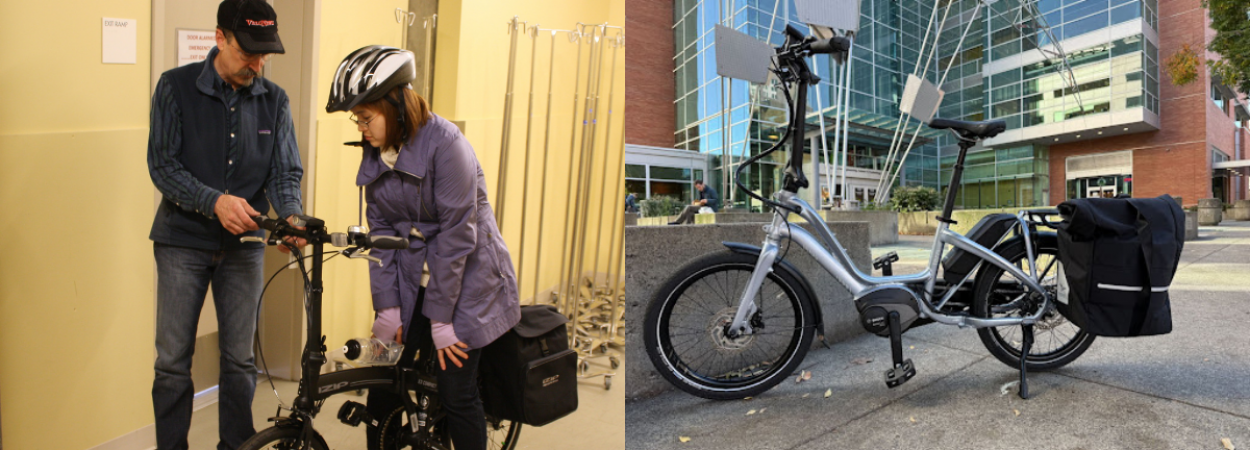
A new report from the Transportation Research and Education Center (TREC) at Portland State University (PSU) finds that e-bike incentive programs across North America are evolving rapidly, with a growing focus on point-of-sale discounts, equity, and safety standards. Check out the online e-bike incentive tracker.
“An Update of E-Bike Purchase Incentive Programs in North America (PDF),” authored by TREC researchers John MacArthur, Kyu Ri Kim, and Cameron Bennett, provides an updated scan of 118 e-bike incentive programs in the United States and Canada. The report builds on a previous 2022 scan and offers insights for policymakers seeking to expand e-bike adoption as a low-carbon transportation option. The research was funded by PacTrans, a U.S. Department of Transportation University Transportation Center, and UL Standards & Engagement (ULSE), a global organization focused on developing and advocating for safety standards across products, services, and systems.
When the e-bike incentive tracker was first published in 2022, ULSE recognized its importance and influence across transportation groups, and viewed a partnership with PSU on the tracker’s update as an important opportunity. They worked with TREC to include information on battery safety standards in the update of the tracker.
"As e-bike adoption continues to grow, safety must grow with it. Requiring bikes and lithium-ion batteries to meet recognized safety standards helps ensure products are tested, certified, and designed to protect riders and communities. We’re hopeful this tool will support the bicycle industry and state and local leaders in adopting these standards to help keep their communities safe," said David McKnight, Vice President of Government Relations & Partnerships at ULSE.
Point-of-sale discounts becoming the norm
E-bikes can replace many short car trips, but their upfront cost—often $1,000 to $4,000—remains a key barrier. The new report shows a major shift in how incentive programs are delivered.
In 2022, most programs used post-purchase rebates, requiring participants to pay upfront and wait for reimbursement. By 2025, many programs had moved to point-of-sale discounts, where the incentive is applied directly at the time of purchase.
This change reflects equity concerns: point-of-sale discounts reduce the need for participants to front the full cost, which can be a significant barrier for lower-income households. Of the 50 programs requiring purchases through local or designated bike shops, 34 now use a point-of-sale model.
Increased support for lower-income households
The report also documents a growing emphasis on income-based incentives. While general incentive amounts have increased modestly since 2022, many programs now offer substantially larger subsidies for income-qualified applicants.
More programs are offering incentives of $1,000 or more—and some exceed $1,500—for lower-income participants. In addition, dozens of programs now restrict eligibility based on income, targeting limited public funds toward households most likely to benefit from financial assistance.
Expansion beyond early-adopting states
While California, Colorado, and Vermont continue to lead in e-bike incentives, the report finds that programs are spreading to new regions. Statewide initiatives have been launched or approved in New Mexico, Minnesota, and Michigan, signaling broader national interest.
Funding levels are also growing. California’s E-Bike Incentive Project has received $31 million since 2021, and Oregon’s Portland Clean Energy Fund E-Bike Rebate Program allocated $20 million beginning in 2025.
Growing attention to battery and fire safety
Battery safety emerged as a major theme in the 2026 update. Following high-profile lithium-ion battery fire incidents—particularly in dense urban areas—many programs now require safety certifications or standards as a condition of eligibility.
About 60 programs have adopted mechanical and electrical standards to reduce fire and crash risks, with increasing reliance on UL certifications for batteries and electrical systems. Some programs also require safety training related to battery handling and safe riding.
ULSE recently released a model policy and comprehensive guide to help institutions safely manage the growing use of e‑bikes and personal mobility devices.
Designing programs in a changing market
The authors note that the e-bike market is facing economic uncertainty, including recent tariffs affecting e-bikes and lithium-ion batteries. These pressures may reduce the purchasing power of incentives, making program design and targeting more important than ever.
About the report and tracker
The white paper accompanies TREC’s E-Bike Incentive Purchase Program Tracker, an online, continually updated resource for agencies, policymakers, and community leaders. Together, the tools provide a snapshot of current policy approaches and help practitioners design programs that expand access to e-bikes, reduce emissions, and improve transportation equity.
TREC researchers also maintain an E-Bike Lending Library Tracker, tracking e-bike lending programs across the United States. Learn more about that project here.
About the funders
Learn more about the project's funders by visiting the UL Standards & Engagement website and the PacTrans website.
Portland State University's Transportation Research and Education Center (TREC) is a multidisciplinary hub for all things transportation. We are home to the Initiative for Bicycle and Pedestrian Innovation (IBPI), the data programs PORTAL and BikePed Portal, the Better Block PSU program, and PSU's membership in PacTrans, the Pacific Northwest Transportation Consortium. Our continuing goal is to produce impactful research and tools for transportation decision makers, expand the diversity and capacity of the workforce, and engage students and professionals through education, seminars, and participation in research. To get updates about what's happening at TREC, sign up for our monthly newsletter or follow us on social media.


