
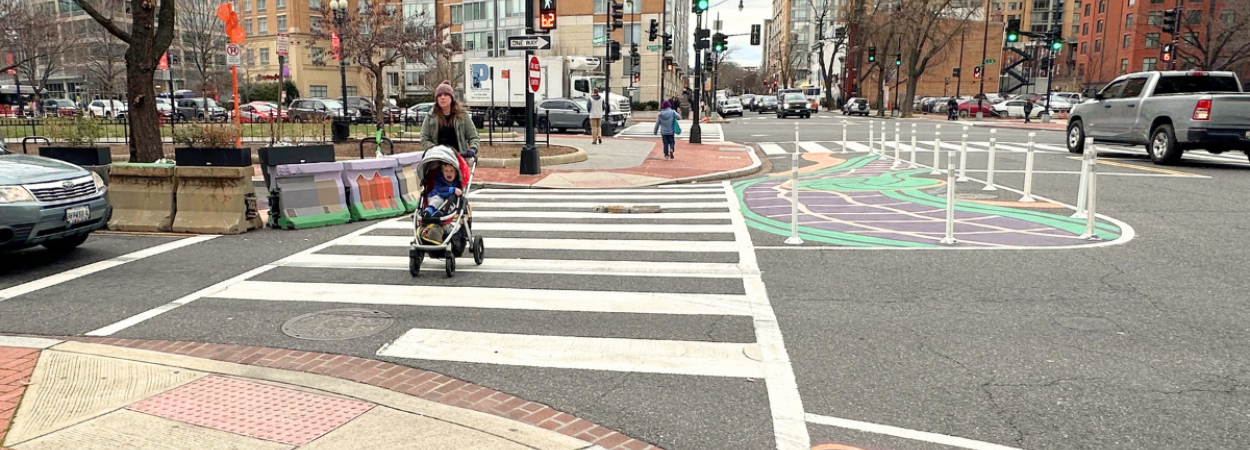
Curb extensions are relatively understudied and there are few robust studies on tactical curb extensions, including those with mural art. This new research aims to change that. The report “Evaluation of Different Curb Extension Treatments for Pedestrian Comfort and Safety at Intersections,” from the Transportation Research and Education Center (TREC) at Portland State University (PSU) and the University of North Carolina (UNC) Highway Safety Research Center (HSRC) is out now.
The study found that curb extensions have statistically significant impacts on pedestrian and motorist behavior and suggests that tactical curb extensions with or without mural art offer a feasible alternative to improve pedestrian satisfaction and safety compared to control locations. Most importantly, all curb extension types encouraged pedestrians to wait further out and more within the mutual sightlines of motorists than control locations, and each type of curb extension was associated with increased motorist yielding.
TREC researchers Nathan McNeil and Sirisha Kothuri focused on the video data collection and survey analysis portion of the project. The report looked at three main types of curb extensions—permanent, tactical, and tactical with mural art—in Washington D.C. and how pedestrians experience comfort and safety at intersections with these curb extensions. They video monitored 25 intersections: five with permanent curb extensions, five with tactical curb extensions, five with tactical curb extensions with mural art, and the rest were control group curbs.
McNeil and Kothuri are now conducting a similar analysis to expand the methodology to sites in the Pacific Northwest through funding from the PacTrans Regional University Transportation Center.
Curb extension types
Permanent curb extensions are safety treatments that push the physical edge of the curb out, extending the sidewalk out at corners. This is intended as a safety measure, increasing the visibility of pedestrians and motorists to one another and shortening crossing distance and time for pedestrians.
In contrast, tactical extensions extend the curb by utilizing relatively low cost and quick build materials such as flexible posts and pavement markings. These are installed without adding any physical concrete to the extension, instead relying on the presence of the quick-build materials to demarcate the curb extension area.
Lastly, tactical extensions with mural art use paint to fill in the space between the flexible posts, pavement marking, and the physical lip of the curb. These installations offer the opportunity to liven up the extension by including fun artwork and bright designs, often designed by and/or reflecting the local community.
Analysis and findings
McNeil and Kothuri led a review of video footage from the 25 intersections. There were 223 hours of video material, 10,573 pedestrians were coded, 45,668 motorists were counted, and 1,396 events of cars yielding to pedestrians.
They reviewed pedestrian waiting behavior and car yielding behavior. For pedestrians waiting for a gap to cross at an uncontrolled intersection, visibility of the pedestrian and motorist to one another is essential. Curb extensions can help extend pedestrians’ waiting positions further out toward the travel lanes. The study looked at pedestrian waiting positions and found that permanent curb extensions were most highly associated with pedestrians waiting in the extension area (84%). At tactical and mural art locations 40% and 35% of pedestrians, respectively, waited in the curb extension area; while not as effective by this metric as permanent curb extensions, these rates represent potentially important improvements in visibility compared to control locations, where no pedestrians obtained this benefit.
Car yielding behavior showed that all types of curb extensions were associated with increased motorist yielding and they did not find statistically significant differences in failure to yield between curb extension types. However, they noted that there was some difference in the type of yielding. When broken down into near vs far side yielding, the variance became clearer. Permanent extensions had the highest yield rate for far side lane through vehicle yield while mural art locations had the highest yield for near side through and turning vehicles.
They also examined instances of motor vehicles driving in or through curb extension areas. Across all locations, such intrusions were rare. Permanent extensions took the lead again, with the lowest number of cars intruding on the extension at 0.2%. Tactical extensions with mural art followed at 0.5%, and then tactical extensions with no mural art at 2.3%.
McNeil and Kothuri also analyzed survey responses. Surveys were conducted at 10 intersections and 180 pedestrians who had just concluded a crossing completed the survey. Combined with the survey and video results, the report found that pedestrians reported the highest perception of safety when they crossed at locations with mural art curb extensions and when they waited at locations with permanent curb extensions.
While permanent curb extensions scored the highest for perceived safety and had the smallest number of motor vehicles intruding on the extension, the installation cost is much higher than the cost of adding a mural and candles. This study suggests that tactical extensions with mural art could strike the balance that many transportation agencies are facing, providing a cost effective protective measure for pedestrian safety in major metropolitan areas.
This study assessed the experiences of sighted pedestrians interacting with these intersections. Further research is needed to assess how these designs work for people with impaired vision or other disabilities.
About the report
The objective of the study was to identify and document factors associated with road user safety and comfort at intersections with permanent versus tactical (both with and without mural art) curb extensions, as well as a set of control locations with no curb extensions.
University of North Carolina (UNC) Highway Safety Research Center (HSRC):
Wesley Kumfer, Ph.D.
Sarah Worth O’Brien
Mike Vann
Portland State University (PSU), Transportation Research and Education Center (TREC)
Nathan McNeil
Sirisha Kothuri, Ph.D.
Minju Kim Song, Ph.D.
TREC graduate students Joe Kortenhoff, James Shelstad and Aidan McClinton (PSU) also helped with this research.
About the funder
The District Department of Transportation (DDOT) is responsible for the management of transportation infrastructure and multimodal transportation network operations for all residents and visitors of the District of Columbia.
Portland State University's Transportation Research and Education Center (TREC) is a multidisciplinary hub for all things transportation. We are home to the Initiative for Bicycle and Pedestrian Innovation (IBPI), the data programs PORTAL and BikePed Portal, the Better Block PSU program, and PSU's membership in PacTrans, the Pacific Northwest Transportation Consortium. Our continuing goal is to produce impactful research and tools for transportation decision makers, expand the diversity and capacity of the workforce, and engage students and professionals through education, seminars, and participation in research. To get updates about what's happening at TREC, sign up for our monthly newsletter or follow us on social media.


