
As the transportation world converges once again on Washington, D.C. for the 105th Annual Meeting of the Transportation Research Board (TRB) next month, researchers, practitioners, and policymakers will come together to explore tomorrow’s mobility challenges. This year, Portland State University (PSU) brings a lineup of work that reflects emerging priorities: multimodal safety, climate resilience, innovative data and modeling approaches, and community-centered planning.
At TRB, held from January 11–15, expect to see PSU presentations that bridge the gap between scholarship and real-world impact. Our faculty, students, and partners continue to contribute to global conversations about the future of mobility.
Below are a few highlights of what PSU researchers are bringing to the program!
January 12, Poster Session: Modeling Behavior-Driven Crash Risks
4:00 PM- 5:45 PM (All times are Eastern Time): Behavioral Safety Research Roundup
Civil Engineering Graduate student Pabitra Kumar Roy and professors Tanmoy Bhowmik and Jason C. Anderson of the Maseeh College of Engineering and Computer Science will present "An Integrated Multivariate Econometric Modeling Framework for Risky Driving Behaviour Related Crashes: Evaluating Crash Risk and Severity Across Zones."
Rapid advancements in crash modeling have yet to fully integrate multiple behavior-driven crash types and their severity outcomes within a single, scalable framework.
This study introduces an integrated multivariate econometric model that jointly analyzes crash frequency and severity for three major behavior-driven crash types: alcohol-related, distraction-related, and aggressive-driving-related crashes.
Using Oregon’s 2022 census block group crash data, the research team developed an Integrated Multivariate Negative Binomial – Generalized Ordered Probit Fractional Split (IMNB–GOPFS) model to examine these factors together while accounting for how one behavior may influence another. Model-fit and predictive performance tests show that this new framework outperforms traditional, non-integrated approaches, underscoring the importance of capturing these interdependencies. A brief elasticity analysis also shows how several key variables affect crash outcomes both directly and through behavior-linked pathways.
The researchers then applied the model to identify high-risk locations. Census block groups with more truck traffic, higher shares of rural and freeway roads, and wider speed-limit variations were consistently linked with elevated crash rates across all three behavioral crash types. By bringing multiple behavior-driven crash types and severity outcomes into one model, this study provides a more complete framework for data-driven safety planning and proactive crash-risk assessment at the planning level.
January 12, Poster Session: Evaluating Oregon’s Urban Speed Limits
10:30 AM- 12:15 PM: Behavioral Safety Research Roundup
Civil Engineering graduate student and Masters of Urban and Regional Planning (MURP) student Elias Peters will present research with Jason C. Anderson on "Evaluating Speed Compliance Outcomes from a Revised Urban Speed Zoning Methodology with Roadway Context and Vulnerable Road User Considerations."
The study examines how drivers’ speed compliance changed after Oregon updated its speed zoning methodology for urban arterials. The new approach, created by the Oregon Department of Transportation, is designed to better reflect the needs of vulnerable road users and the context of urban streets.
Researchers collected spot speed data at 35 locations across 10 speed zones in the Portland metro area. They used descriptive and statistical analyses to compare vehicle speeds before and after speed limits were lowered.
The findings show that average speeds often dropped after the new limits were posted, but compliance varied widely. Many locations still saw high levels of speeding. The biggest reductions in speed and speeding occurred where speed limits were lowered by 10 mph.
Overall, the results paint a mixed picture. While lower posted limits frequently led to modest decreases in average speeds, widespread non-compliance suggests that changing speed limits alone is not enough. Additional street design changes, enforcement, or education efforts may be needed to achieve lasting safety improvements.
“I am excited to attend TRB for the first time, especially to present on a topic I care deeply about. I’m drawn to research that has a direct impact on safety for people walking, biking, and taking transit. My goal is to build a career focused on making transportation systems safer, more accessible, and more equitable. I believe we build community through connection, and transportation is quite literally what connects us to our world. I want to help create systems where everyone feels comfortable, safe, and free to engage in their community," Peters said.
January 14, Poster Session: E-Bikes and Changing Travel Choices
8:00 AM- 9:45 AM: Behavioral Insights into Mode and Route Choices
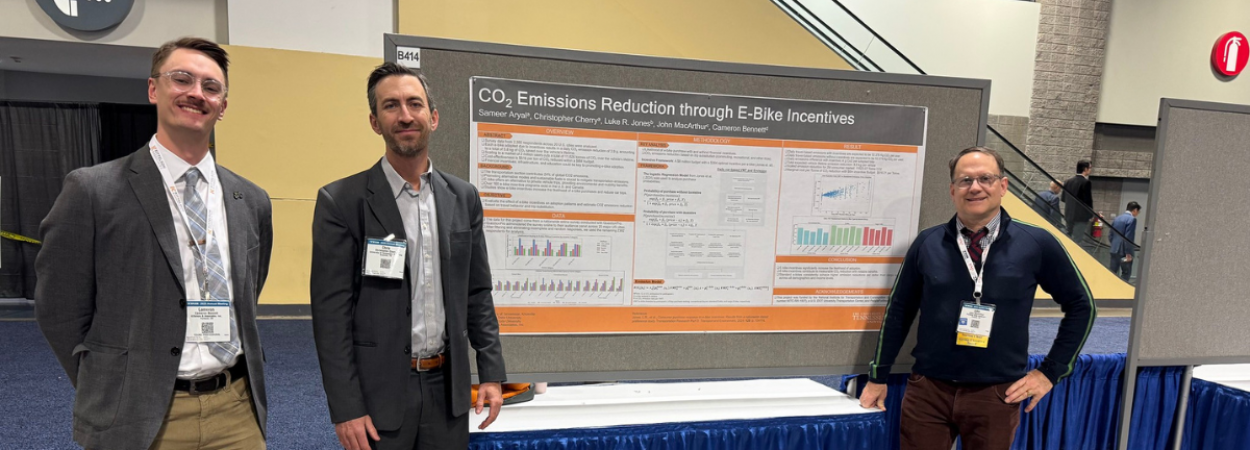
John MacArthur of Portland State, with Sameer Aryal and Christopher Cherry of the University of Tennessee, Knoxville, and Cameron Bennett of Kittelson & Associates, will present "Mode Substitution Patterns Among U.S. E-Bike Owners: Evidence from Pooled 2017 and 2023 Survey Data."
Understanding how e-bikes fit into transportation systems requires knowing how they change travel behavior—specifically, how e-bike trips replace, complement, or enable other modes of travel. While past research has shown that e-bikes can replace car trips, there is limited evidence in the U.S. on how substitution patterns vary across users, trip types, and over time.
This study uses a combined dataset from national e-bike owner surveys conducted in 2017 and 2023. The research team applied a pooled multinomial logit model to examine how substitution patterns differ by user type, trip purpose, prior biking frequency, current e-bike use, prior mode use, and survey year. The results show significant variation and changes in behavior over time. Users who biked less before adopting an e-bike and who use their e-bike more often are more likely to replace car, transit, or shared car trips, especially for everyday utilitarian trips. Substitution patterns also shifted in 2023: newer adopters are increasingly replacing transit and bike-based trips. Prior mode use continues to strongly influence substitution outcomes.
These findings provide new evidence on how e-bike substitution behavior is evolving in the U.S. They show both the potential to reduce car travel and possible unintended effects, like reduced transit use. Effective e-bike policies will need to consider trip purpose, rider type, and local travel options to support sustainable mobility goals.
Portland State University's Transportation Research and Education Center (TREC) is a multidisciplinary hub for all things transportation. We are home to the Initiative for Bicycle and Pedestrian Innovation (IBPI), the data programs PORTAL and BikePed Portal, the Better Block PSU program, and PSU's membership in PacTrans, the Pacific Northwest Transportation Consortium. Our continuing goal is to produce impactful research and tools for transportation decision makers, expand the diversity and capacity of the workforce, and engage students and professionals through education, seminars, and participation in research. To get updates about what's happening at TREC, sign up for our monthly newsletter or follow us on social media.


