
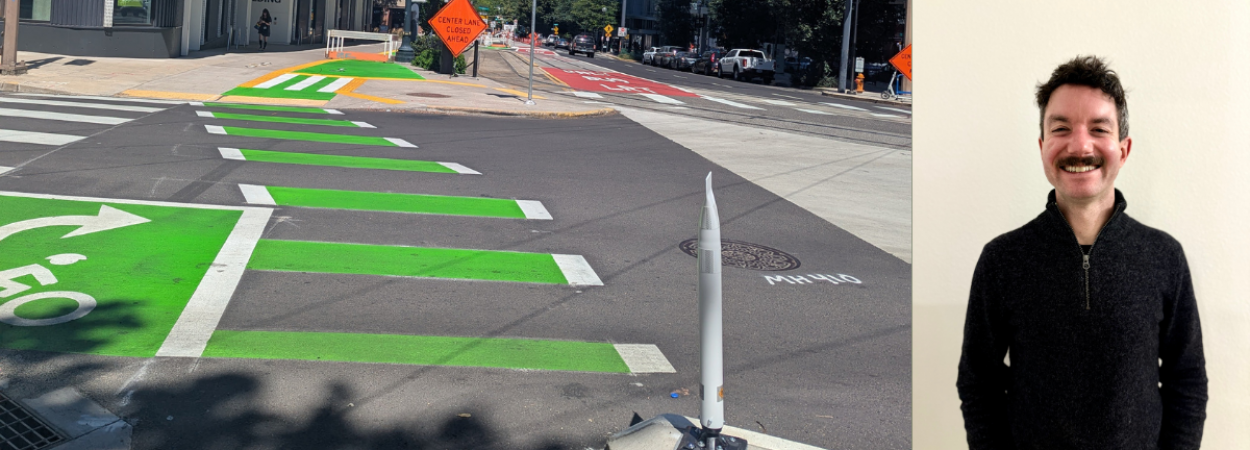
Adam Moore graduated from Portland State University in 2012 with a Master's of Science in Civil Engineering. He now works as a traffic engineer for the Portland Bureau of Transportation (PBOT) in Portland, Oregon, where he helped shape the signals and street lighting for Portland's SW Fourth Avenue Improvement Project. BikePortland rode the new 4th Ave route as soon as it opened – check out the video here!
What do you do in your current role, and what does a typical day look like?
I work at the Portland Bureau of Transportation as a traffic engineer in the Signals, Street Lighting, and ITS (Intelligent Transportation Systems) Division. I focus on Southwest Portland, where I oversee a few hundred traffic signals and several thousand street lights. My job entails every aspect of signal and street lighting asset management: concept, design, construction, maintenance, operations, and eventual decommissioning. No two days are the same for me – I might start the day reviewing a design plan for an upcoming traffic signal project, then I’ll make a site visit to assist a contractor with a challenging street light pole installation, before returning to my desk and addressing signal operations comments from the public.
How did your experience at PSU shape your path into the transportation field?
PSU connected me to professionals in the region by encouraging me to join student organizations like STEP: Students in Transportation Engineering and Planning. Through STEP, I met many transportation engineers who, to this day, have helped guide my career. It was also STEP that pointed me to an internship at PBOT. I was able to make an immediate contribution once I started my internship thanks to the data analysis skills I’d gained in several courses at PSU – a project had just been completed that rebuilt a few traffic signals near a railroad crossing, and I was able to show that frequent train events were affecting signal operations, which eventually led to a conversation with the railroad about upgrading their equipment to decrease train disruptiveness.
What advice would you give to current students or recent grads interested in a career in transportation?
Network! Coursework is very important, but so is talking with professionals. It’s how you learn the ins and outs of your field and get a true understanding for what a “day in the life” is like. Without networking, I may never have realized what a great fit traffic signals and street lights are for my career interests. Joining student organizations is a great way to learn about events, and it’s less intimidating to attend with a group of fellow students, but don’t be afraid to go sit at a table with a bunch of professionals you’ve never met – I guarantee you’ll have an interesting conversation, perhaps learn a bit about your field that you’d never expected, and maybe even hear about upcoming internship opportunities.
What’s one project or accomplishment you’re especially proud of in your career so far?
I’m just wrapping up work on the $21 million SW 4th Ave “Central City in Motion” project, which has been a big part of my professional life since it began design about five years ago. The project rebuilt SW 4th Ave through the heart of downtown, adding a new bike lane, transit lanes, and improvements for pedestrians and drivers as well. I led the signal and street lighting components of the project through design and construction. Construction was particularly challenging as we navigated many conflicts to install poles and electrical conduits. Now I’m fine-tuning the operations by programming the signals, making observations, and adjusting parameters to ensure all users are served safely, efficiently, and intuitively.
Portland State University's Transportation Research and Education Center (TREC) is a multidisciplinary hub for all things transportation. We are home to the Initiative for Bicycle and Pedestrian Innovation (IBPI), the data programs PORTAL and BikePed Portal, the Better Block PSU program, and PSU's membership in PacTrans, the Pacific Northwest Transportation Consortium. Our continuing goal is to produce impactful research and tools for transportation decision makers, expand the diversity and capacity of the workforce, and engage students and professionals through education, seminars, and participation in research. To get updates about what's happening at TREC, sign up for our monthly newsletter or follow us on social media.


