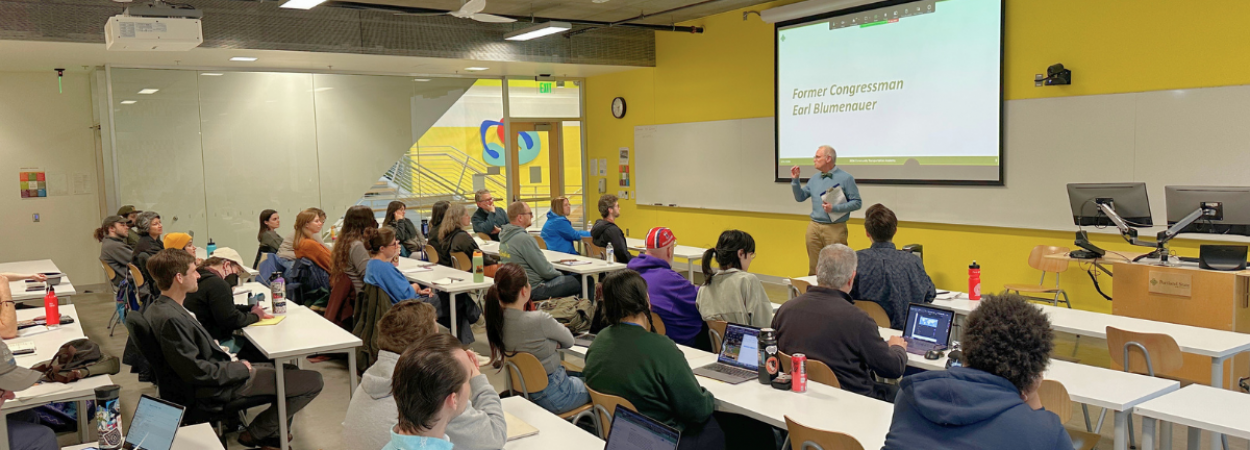
Former Congressman Earl Blumenauer presents to the 2026 Community Transportation Academy cohort.
“This incredible curriculum seriously upleveled my knowledge base and confidence level to become more active in transit advocacy,” 2026 Community Transportation Academy (CTA) attendee Lauren Armony said. “[It] gave me, an adult community member, the rare and exciting opportunity to learn more about regional transportation policy and planning with university students, and meet other interested peers for free!”
As the 2026 CTA comes to an end, we reflect on this program’s history, growth, and impact. The CTA helps community members familiarize themselves with the agencies, plans, decisions, investments, and discussions that result in transportation systems. State and local transportation topics are covered, delivered by PSU faculty, researchers, and transportation experts from Portland and beyond. This year Portland State University (PSU) partnered with Metro, TriMet and the Oregon Department of Transportation (ODOT) to deliver the 10-week class. Metro took responsibility for the class in 2024.
“The Community Transportation Academy offers people living in the greater Portland region an opportunity to better understand the complex nature of transportation policy and funding and to apply that lens to their local communities,” Hau Hagedorn, Community Investments Manager at Metro said. “I am pleased to see the range of transportation issues identified by class participants and the thoughtfulness in which they considered and weighed solutions. I look forward to seeing if any of the projects make its way into local transportation plans and projects.”
The CTA iterates upon the previous Portland Traffic and Transportation class which began in 1991, was spearheaded by former Congressman Earl Blumenauer, and operated by the Portland Bureau of Transportation (PBOT) in partnership with PSU for many years, before shifting over to Metro. In 2015, TREC Research Associate and 2026 CTA co-instructor Nathan McNeil published a study documenting the impact of the original class. The study found many attendees post-class had engaged with and successfully improved their local transportation systems due in part to learning how to effectively navigate and participate in transportation decision-making processes. That led to a collaborative effort with the University of Utah to launch a similar academy in Salt Lake City.
This year the class, re-envisioned as the Community Transportation Academy, returned to PSU. McNeil and Dr. Jennifer Dill, professor of Urban Studies and Planning and TREC Director, led the class, which combined community members with PSU undergraduates who took the class for credit towards their degrees. They covered key transportation concepts, safe streets and Vision Zero, how streets are designed and operated, who the decision-makers are in transportation and how to get involved, how transit connects and shapes communities, and more. The class was free for community members, open to Oregon residents, and stipends were provided for eligible participants to offset child care or transportation costs to attend.
“I am quite new to Portland but found myself learning not just more about the various planning mechanisms in the region, but also the history of Portland...its historic streetcars, bike infrastructure, and everything in between. And the speakers seemed well chosen and offered a nice mix,” 2026 CTA participant Andrew Mancini said.
Attendees had the option to generate a project throughout the course that explored a transportation issue of personal interest by identifying, evaluating, and proposing possible solutions. This year, class projects included improving bus stops, fixing key gaps in sidewalk networks, envisioning weekly mini-Sunday Parkways events, addressing highway noise pollution, and more.
Previous class projects of the Portland Traffic and Transportation class included proposing a safer route to Bridlemile School by David Stein, a safer SW Salmon Street by Ross Peizer, safer routes to Bridger School by Amy Wren, and parking benefit districts.
“I found myself enjoying the speakers and also being inspired by the variety of classmates who shared their projects, week to week, and especially at the end with the presentations. That feeling that one can make a difference seems especially important these days, when every other news headline tends to impress the opposite,” Mancini said. “I'd suggest the class to anyone looking to learn more about Portland, anyone curious about the planning world and the seemingly complex "behind-the-scenes" work that goes into it, and anyone just wanting to feel like they can make a difference in their community.”
Portland State University's Transportation Research and Education Center (TREC) is a multidisciplinary hub for all things transportation. We are home to the Initiative for Bicycle and Pedestrian Innovation (IBPI), the data programs PORTAL and BikePed Portal, the Better Block PSU program, and PSU's membership in PacTrans, the Pacific Northwest Transportation Consortium. Our continuing goal is to produce impactful research and tools for transportation decision makers, expand the diversity and capacity of the workforce, and engage students and professionals through education, seminars, and participation in research. To get updates about what's happening at TREC, sign up for our monthly newsletter or follow us on social media.


