
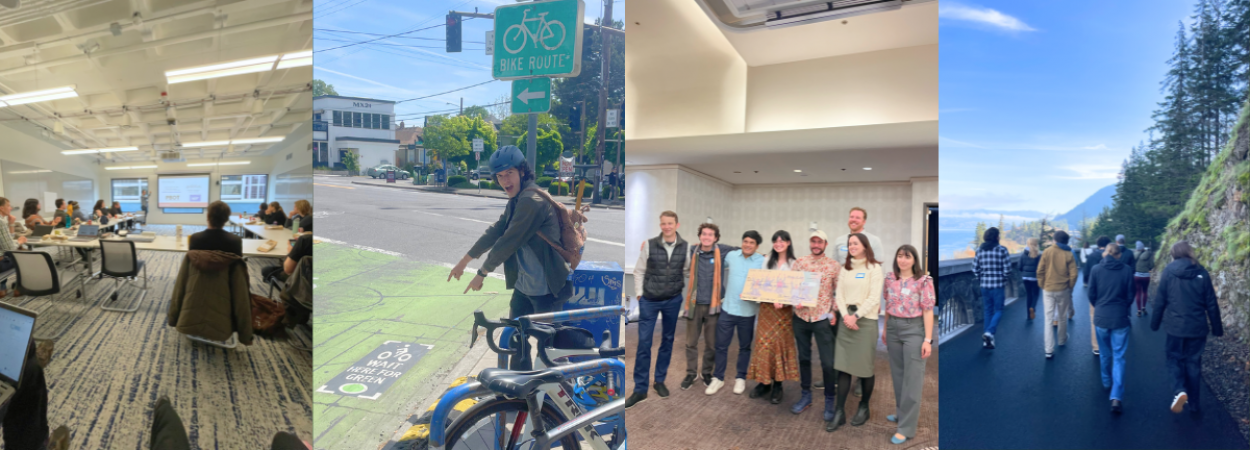
ITE-STEP has hosted and participated in activities from presentations with local transportation experts, bike rides, transportation knowledge competition, and walking paths exploring what Portland and surrounding areas has to offer.
The Students in Transportation Engineering and Planning (ITE-STEP) at Portland State University (PSU) has been a key conduit for creating opportunities for professional and academic development. The club is supported by PSU’s Student Activities and Leadership Programs and PacTrans and also serves as the student chapter for the Institute of Transportation Engineers (ITE). With the end of the academic year, we wanted to share more about these student leaders.
For outgoing ITE-STEP President Elias Peters, public transit and active transportation systems represent connection and freedom. Peters grew up in a fairly car-centric place, and one of their earliest joys was getting to take the hour-long bus ride into the city when their mom’s car was being repaired.
“As I grew older, I began to feel that the most valuable people in the city were the people who knew how to get anywhere via any mode, which meant that to me, city heroes were people who were well versed in taking the bus, walking, and biking. I wanted to be like those people - people who were connected with all of their city, inside and out, not just the parts of it they were familiar with,” Peters said. “To me, that was the biggest sign of respect to your community, being so connected with the place surrounding you that you were able to have connections anywhere, with anyone, whether they be physical or social, and you were able to navigate freely within that space.”
Witnessing ways that current transportation systems fail to create connection motivated Peters to improve transportation systems to better facilitate connection and community. They joined the STEP leadership team in 2023 which influenced their pathway into the field. Since then, they have expanded into the transportation community further, serving as a Transportation Ambassador with PBOT, volunteering at Sunday Parkways, and volunteering for the Portland Summer Bicycle Counts.
In the past school year, the club placed second in the Oregon ITE Chapter's annual Traffic Bowl for the second consecutive year. They collaborated with organizations such as the Portland Bureau of Transportation (PBOT), Oregon Department of Transportation (ODOT), Young Professionals in Transportation (YPT), Fehr and Peers, and TriMet, growing connections between PSU student body and the Portland community. Club officers had the opportunity to volunteer at the Community Cycling Center's Transportation Trivia Event where they helped raise over $20,000 for programs that equip Portlanders with the confidence, skills, and resources to bike.
The chapter also partnered with other PSU student organizations for the first time in two years such as Planning Club and BIPOC Planners Club, and partnered with TREC to connect PSU students, staff, faculty, and researchers. For the first time in several years, STEP gathered students to volunteer at Sunday Parkways and enabled $150 to be donated to City Repair.
These efforts have increased their membership and connection with undergraduate students, leadership team, and student interest. The incoming leadership team exemplifies this, as the number of incoming officers has doubled and more than half are in the undergraduate Community, Urban Studies & Planning (CUSP) program at PSU.
David Archuleta, outgoing ITE-STEP officer, was also drawn to the sense of freedom in active transportation systems. Like Peters, he grew up in a car-centric area. When he moved to Seattle, WA he realized the magnitude of empowerment that public transportation can offer, and after moving to Portland for the Masters in Urban and Regional Planning (MURP) program at PSU, he joined ITE-STEP.
“We've been able to broaden the transportation focus of our chapter by emphasizing the connection it has with land use, and considering how each side influences each other. We all still love transportation, but I like that we're thinking more about the bigger picture,” Archuleta said. “My experience at PSU has helped me see how deeply transportation is connected to equity, sustainability, safety, land use, and quality of life. [This] has encouraged me to think critically about who transportation systems serve, who they leave out, and how better planning and design can create more accessible and sustainable cities.”
The idea of access—considering who transportation systems are designed by and for and who is not involved in the process—has been a guiding and grounding notion for Sammy Won, continuing member and incoming President and Leader of Coordination. If not for a serendipitous conversation with a transportation researcher and professor in her undergraduate experience, she never would have considered transportation or urban planning as a career option.
“Being able to openly ask questions during her office hours that challenged my assumptions about what research and work looks like in transportation made me see how I could fit into the field,” Won said. “Equally as important, as someone who lives car-free and cannot drive, I am intimately familiar with how much someone's world can open up when they have access to a public transportation system and know how to use it.”
Won has enjoyed exploring the variety of topics that intersect with transportation with her peers and says she loves building relationships between her fellow students and working professionals.
“There are so many opportunities and pathways in the transportation space, and I think the first step to getting into them is knowing they exist,” she said. “Being able to have conversations and ask questions with professors and researchers who care deeply about transportation issues at PSU has been one of the most valuable and influential aspects of studying here. The conversations I have had here at PSU have made me critically question commonly repeated assumptions about transportation and have made me better prepared to think about transportation problems today and in the future.”
New incoming 2026-2027 team members share similar sentiments. Jacob Groh will serve as the Social Chair, Lydia Ivanovic as the Community Engagement Chair, Ross McPherson as the Leader of Events, Conferences, & DEI Chair as well as the Leader of Communications and Traffic Bowl Chair, Amy Miners as Leader of Finances, and Lilia Perez-Duran as Committee of Fun Chair.
Ivanovic became acutely aware of the inequitable forces in transportation planning and service provision based on her experiences living in tight knit rural communities before moving to Portland and agrees with Won’s sentiment of thinking more critically about the industry.
“I saw how the lack of transportation options remains one of the biggest infrastructure gaps; I had never owned a car until serving as an AmeriCorps member, and it became my most pressing expense as well as sole connector to remote community members,” Ivanovic said. “As a Portland resident and emerging planner, I aim to apply my service experience to ensure the use of justice-oriented approaches to defining and delivering transit access.”
Follow their events to get involved!


