
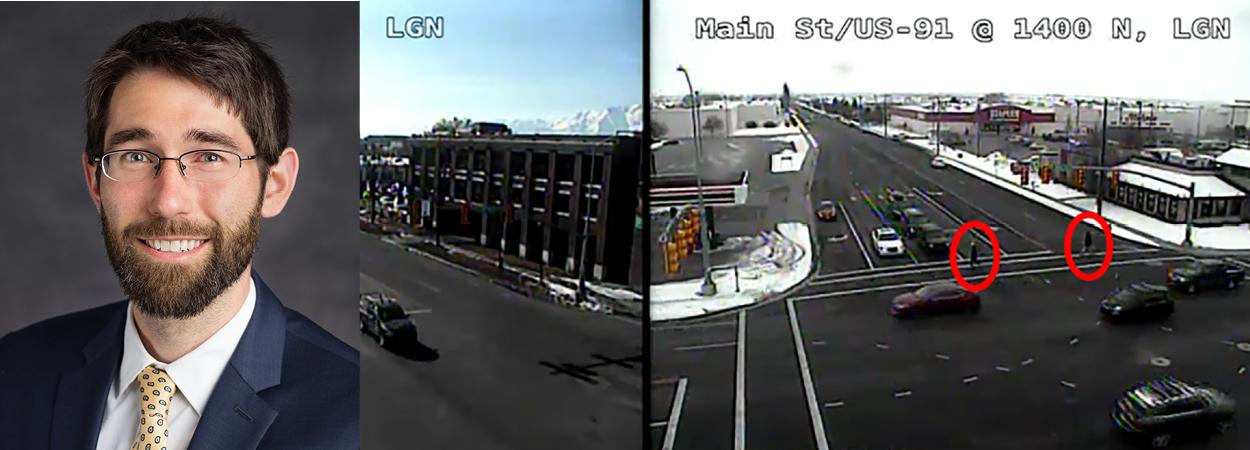
Through a series of research projects in Utah and Oregon (including a collaboration with PSU's Sirisha Kothuri), Patrick's research has demonstrated the value of pedestrian push-button data for helping monitor and estimate pedestrian crossing volumes at signalized intersections.
Patrick Singleton graduated from Portland State University's Civil and Environmental Engineering (CEE) program with a Ph.D. in 2017. He now works as an Associate Professor in transportation at Utah State University, researching travel behavior, transportation planning, and traffic safety.
What do you do in your current role, and what does a typical day look like?
My current role as an associate professor involves a combination of research, teaching, and service. In research, I lead transportation research projects in areas from traffic safety to transportation electrification, managing employees (mostly students), meeting with clients, collecting and analyzing primary and secondary data, preparing manuscripts and reports, and giving presentations. I also pursue new research ideas and write grant proposals for research funding. In teaching, I teach students directly in transportation CEE courses (like transportation data analysis and research methods). I also train graduate and undergraduate students, helping to develop their professional skills and supervising their projects, theses, and dissertations. In service, I peer review papers, help run my department and college, contribute to professional organizations, and mentor other newer professors.
No day looks the same. One exciting thing about being a professor is there is always something new and challenging to do! One day could involve grading homework, meeting with my research students, preparing a conference presentation, working on five different research projects, and getting ready for field work. It is hard work with high expectations, requiring strong organizational and communication skills.
One thing I didn’t expect from being a professor in the US is that, in addition to being a classroom teacher, you are basically running an apprenticeship and a small business within the university. I have to continuously apply for research project funding to support me and my students, managing projects and my workforce. At the same time, my undergraduate and graduate students are my apprentices, and I mentor and train them for a transportation career through on-the-job (research) training. It is hard! But the most valuable rewards to me are: (1) seeing my students grow, mature, and leave for successful careers; and (2) being able to engage my curiosity and contribute knowledge through research that hopefully improves the transportation system and people’s quality-of-life.
How did your experience at PSU shape your path into the transportation field?
PSU was absolutely instrumental to my professional advancement. I started at PSU wanting to enhance my technical skills in this interdisciplinary field of transportation, and see what research was like. I left PSU with a PhD, a passion for transportation research and education, and an assistant professor job. This was in large part due to the people I got to work with: the course instructors who left me well-trained in many areas (travel behavior, transportation planning, statistics, etc.), my advisor (Kelly Clifton) and the other professors who taught me how to do research, and the other students I learned alongside, many of whom remain collaborators and friends.
PSU’s systems and environment also set me up for success: the research projects and funding opportunities through TREC, the close collaboration between Civil Engineering and Urban Planning, and the “living laboratory” and vibrant transportation communities of Portland. I’m really glad I chose PSU for grad school!
What advice would you give to current students or recent grads interested in a career in transportation?
There are two things about the transportation field that continue to motivate me. First, transportation invites contributions from many different fields, disciplines, and approaches: engineering, planning, computer science, economics, psychology, sociology, etc. I view it as the most “human” of the civil engineering subfields. Second, the transportation field is changing rapidly. Just look at new vehicles and ways of getting around (micromobility, autonomous vehicles, advanced air mobility), or the exponential growth in transportation-related data made possible through sensing technology and other advances.
Together, these observations lead to my advice: Current/Prospective Students: Find your own path in the transportation industry. Everyone has their own story of how they found themselves with a career in transportation. We all started from different places. Work hard, say “yes” to new opportunities, and find the place/role that fits. And don’t give up! Recent Grads: Learning doesn’t stop when you graduate. Keep up on the latest developments, through conferences/workshops/webinars, professional organizations, and networking. Maybe you are the one pushing the field forward!
What’s one project or accomplishment you’re especially proud of in your career so far?
Besides seeing my own students grow and succeed, I’m especially proud of the work I’ve been able to do to advance pedestrian monitoring through traffic signal proxy data. Through a series of research projects in Utah and Oregon (including a collaboration with Sirisha Kothuri), we have demonstrated the value of pedestrian push-button data for helping monitor and estimate pedestrian crossing volumes at signalized intersections.
We’ve processed massive datasets, linked them with pedestrian count observations, developed models, published papers, and presented at many conferences. These data have also helped us develop time-sensitive direct demand pedestrian volume models and robust measures of exposure for pedestrian safety analysis.
I’m especially proud of having had the opportunity to translate our research into practical tools that transportation professionals can use. Specifically, we’ve worked with the Utah Department of Transportation to integrate our pedestrian volume models into their Automated Traffic Signal Performance Measures (ATSPM) system. And we’ve worked with the Oregon Department of Transportation to add push-button data to TREC’s BikePed Portal. Altogether, these efforts have the potential to add thousands of pedestrian traffic monitoring locations, providing a much richer source of pedestrian data than is currently available.


