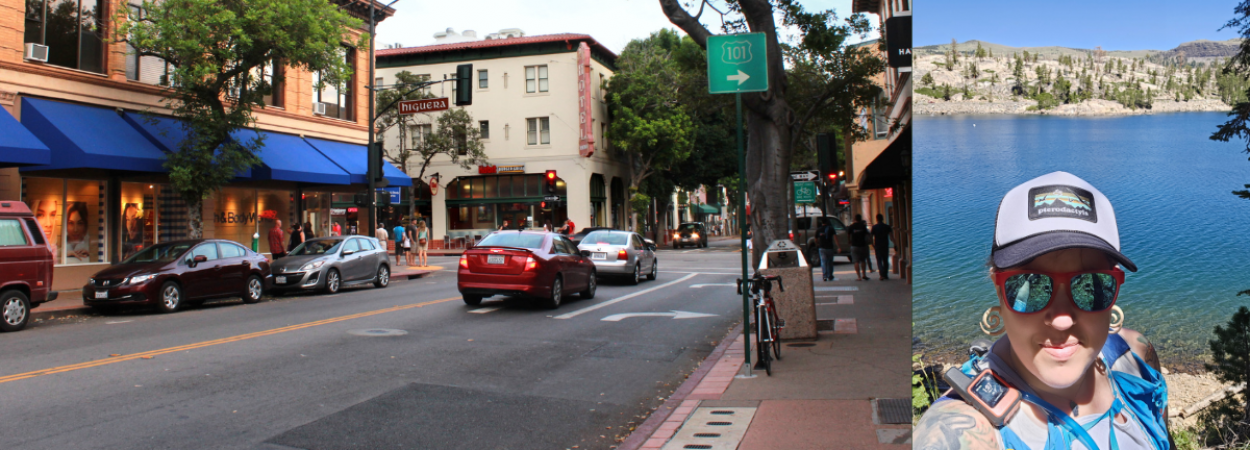
Tara Goddard graduated from Portland State University in 2017 with a Ph.D. in Urban Studies & Planning. She now works as an assistant professor of civil engineering at California Polytechnic State University in San Luis Obispo, California. Previously, she was an assistant, then associate, professor of urban planning at Texas A&M University.
What do you do in your current role, and what does a typical day look like?
Like most faculty, my days vary a lot, which is something I love about being an academic. Depending on the day of the week, my time is differently split between teaching, research, and service or administrative tasks. For teaching, I may be prepping class or lab, doing teacher trainings, teaching class and lab, grading, arranging guest speakers or field visits, or talking with students in office hours. For research, I may have meetings with research team members/collaborators, writing grant applications, doing research design or data collection, data analysis, writing, editing, or reading other people's research. For service, I am a co-advisor for our student Institute of Transportation Engineers chapter, I serve as an editor for the new journal Safety Findings and am involved in various departmental or curriculum tasks. And that's not an exhaustive list - academia is better for those who like variety rather than getting to focus deeply on any one topic or tasks (except during your PhD itself).
How did your experience at PSU shape your path into the transportation field?
I am so grateful that I did my doctoral work in Urban Studies at Portland State. It added a lot of dimension to my previous academic and work experience. One aspect was being in an urban studies department, and getting introduced to a much broader scholarship related to how we build, move around in, operate, control, and contest the public realm. Before Portland State, I'm not sure that I could have told you what critical geography or sociology were, but being around faculty and peers with these backgrounds or research approaches really helped me give me a bigger "vocabulary" and understanding of different disciplinary approaches and theories and how they might inform my own work.
And of course a key reason for my really enjoyable and successful time at PSU were the Transportation Research and Education Center (TREC), the National Institute for Transportation and Communities (NITC), and the community that comprised them. I worked on projects and connected with colleagues that resulted in research both during my program and that continues even now, nine years since I graduated. Being in Portland, of course, was also a wonderful place, being a city that leads the US in a lot of transportation and land use measures. The "living lab" concept can apply not only to teaching or research, but also daily living!
Finally, I was fortunate to get to travel quite a bit to conferences abroad, which provided opportunities to connect with international scholars and see the transportation and land use systems in other countries, which was really formative for me.
What advice would you give to current students or recent grads interested in a career in transportation?
At the great risk of sounding trite, be curious! Become a student of your environment, whether in your neighborhood, city, or on your travels. Learning to see the systems that underlie our transportation and land use can help you see what works, and what doesn't, and what open questions we have. It can feel like a challenge when you feel like you are trying to narrow in on a career, but the wide variety of what is transportation means there really is something for everyone (I admit I'm biased, but still). Policy, design, planning, building, operating, funding, the law - whatever your area of interest or skill, there is something. And as with any discipline, do what you can to meet people, make connections, be helpful and kind, and doors are more likely to open when you knock. I know that sounds cheesy, but it is also true.
What’s one project or accomplishment you’re especially proud of in your career so far?
One research project I worked on that hasn't gotten quite as much notice as some of my other work, although we did publish a piece in The Conversation, is a project I did with some colleagues and our partners in an organization of formerly incarcerated women called Lioness. The leaders and members of Lioness work on improving the lives of system-impacted people, both during and after incarceration. We were working with them to explore the experiences of women who had been incarcerated during major disasters (like Hurricane Harvey), including evacuation situations.
But what makes me proud of that work beyond the topic was the process. We (the academic researchers) co-developed the research idea and grant proposal with the women from Lioness, worked closely on all aspects of research design, and then we (the researchers) served in a support role rather than a leading one for the focus groups. We also wrote the grant so that the advocacy group members were compensated equally to us researchers, and our focus group participants got meaningful compensation. We also held our focus groups in house rentals rather than institutional settings and made food for participants. This made the project more successful on several levels, and it was really rewarding to be part of a project where, to the extent possible, there was true "power-sharing" between us academics and our community partners.
Portland State University's Transportation Research and Education Center (TREC) is a multidisciplinary hub for all things transportation. We are home to the Initiative for Bicycle and Pedestrian Innovation (IBPI), the data programs PORTAL and BikePed Portal, the Better Block PSU program, and PSU's membership in PacTrans, the Pacific Northwest Transportation Consortium. Our continuing goal is to produce impactful research and tools for transportation decision makers, expand the diversity and capacity of the workforce, and engage students and professionals through education, seminars, and participation in research. To get updates about what's happening at TREC, sign up for our monthly newsletter or follow us on social media.


