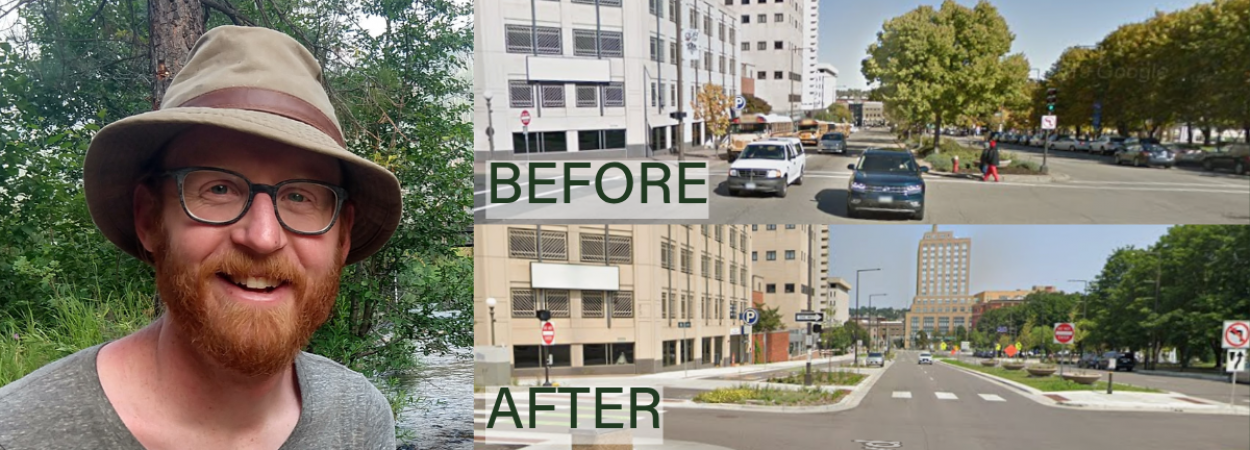
Kirk Paulsen wears a hat and glasses and smiles in front of a background of trees and a river. Paulsen, now a Senior Engineer at Parametrix, previously worked as a Transportation Engineer at Alta Planning + Design where he contributed to a Kellogg boulevard redesign which is shown above. The before image features a boulevard with a parking lane and three driving lanes in each direction separated by a green median. The after image reveals the changes: a bi-directional bike path protected by a nature strip and two lanes of traffic in each direction separated by another green median, with bump outs into the reservation for parking.
Kirk Paulsen graduated from Portland State University in 2018 with a Masters of Science in Civil Engineering. He now works as a Senior Engineer at Parametrix’s Portland location. Previously, he was a Transportation Engineer at Alta Planning + Design and a Traffic Analyst at various firms in Portland/Seattle.
What do you do in your current role, and what does a typical day look like?
I focus on active transportation design, with a primary interest in advancing innovative bike facilities during the early stages of project development. A typical day frequently has me working across the company assisting with active transportation feasibility reviews, providing niche design guidance recommendations, mentoring developing staff, developing 3D roadway renderings, and acting as the design lead on projects through the review of design plans and cost estimates.
How did your experience at PSU shape your path into the transportation field?
My experience at PSU significantly shaped my path into the transportation field for the better. Prior to enrolling at PSU, I was unsure how to utilize my traditional undergraduate degree in civil engineering in a fulfilling manner at the time that the idea of sustainable transportation engineering was just starting to take shape. PSU exposed me to all sorts of new and exciting opportunities such as studying abroad in the Netherlands, collaborating with planners in the MURP program, fostering quality relationships with local agency staff, and attending a variety of transportation conferences across the country. PSU was exactly the type of springboard I was looking for to send my career in a more meaningful direction.
What advice would you give to current students or recent grads interested in a career in transportation?
The learning doesn't stop once you graduate. Actively encourage yourself to be a sponge, ask lots of questions, and learn as much as you can from others about different aspects of transportation before you'll likely settle in on a particular area of focus. Even if something seems irrelevant to you now, it'll likely come in handy later down the road. Transportation is special in how it so frequently intersects with many of the other civil engineering disciplines; therefore, it greatly helps to better understand these underlying relationships.
What’s one project or accomplishment you’re especially proud of in your career so far?
One of the more transformative projects for me that I had the privilege to work on was when I was previously with Alta Planning + Design and worked on the Kellogg Boulevard Phase 1 project as part of the City of Saint Paul’s Capital City Bikeway network. We were tasked with significantly refining a preliminary concept that was developed by others to deliver a detailed 30% design footprint to the prime consultant so they could chop it up and turn the design into engineering plan sheets. A few key takeaways that made this a favorite project of mine: 1) the project continued to build-out the City’s adopted plan for a connected “All Ages and Abilities” bike network in downtown relying on high-quality predefined design standards, 2) there was an ability as designers to advocate for and introduce key safety improvements at side street intersections that weren’t part of the original concept, and 3) the full reconstruction of the corridor and relocation of the center median pushed me outside my comfort zone to teach me that human-centric city-building often benefits from an ability to dream big and not let near-term impacts get in the way of the grander vision of what will be best for the community decades later (e.g. near-term tree impacts associated w/ relocating the median). Lessons learned from that project continue to shape how I approach my projects today. Google street view before and after.


